Introduction
The U.S. fast-food industry has been moving fast. Leading fast-food restaurant locations in the USA have focused on expanding their foothold with aggressive franchising strategies, digital ordering, and efficient delivery systems. McDonald’s, Starbucks, and Subway are examples of companies that continue to be market leaders with a wide reach and strong brands. But there are still opportunities for expansion due to regional differences, changing consumer tastes, and unserved market segments. The report includes an analysis of the top fast food chains in the United States and their competitive positions, and additionally emphasizes the market gaps that offer opportunities for future business growth.
Overview of the U.S. Fast Food Market
The U.S. fast food industry is one of the largest and most competitive segments of the foodservice industry. Limited-service restaurants accounted for 36.5% of all food-away-from-home spending, generating USD 516.1 billion in sales in 2025, according to the U.S. Department of Agriculture Economic Research Service.
The big names in the business McDonald’s, Starbucks, Subway, Chick-fil-A and Taco Bell dominate the market and compete on everything from franchising to digital ordering, delivery services and menu innovation. Still, high competition, shifting consumer tastes, and regional markets left wanting create avenues for business growth and innovation.
Who Leads the U.S. Fast Food Market?
The US market is characterised by a highly developed and brand-saturated competitive market landscape where popular fast food chains in the USA maintain consumer awareness. Subway remains the industry leader in terms of sales and brand recognition. The US market is characterised by a highly developed and brand-saturated competitive market landscape where popular fast food chains in the USA maintain consumer awareness. McDonald’s remains the industry leader in terms of sales and brand recognition. Other brands like Starbucks, McDonald’s, Hunt Brothers Pizza, Taco Bell, and Dunkin Donuts maintain their competitive advantage by investing in digital ordering, loyalty programs, drive-thru services, delivery partnerships, and frequently rolling out new menu items. They have a wide geographic presence, are efficient in operations, and have a loyal customer base, which helps them to dominate the competitive US fast food industry.
Top Fast Food Chains in The United States by Location Count
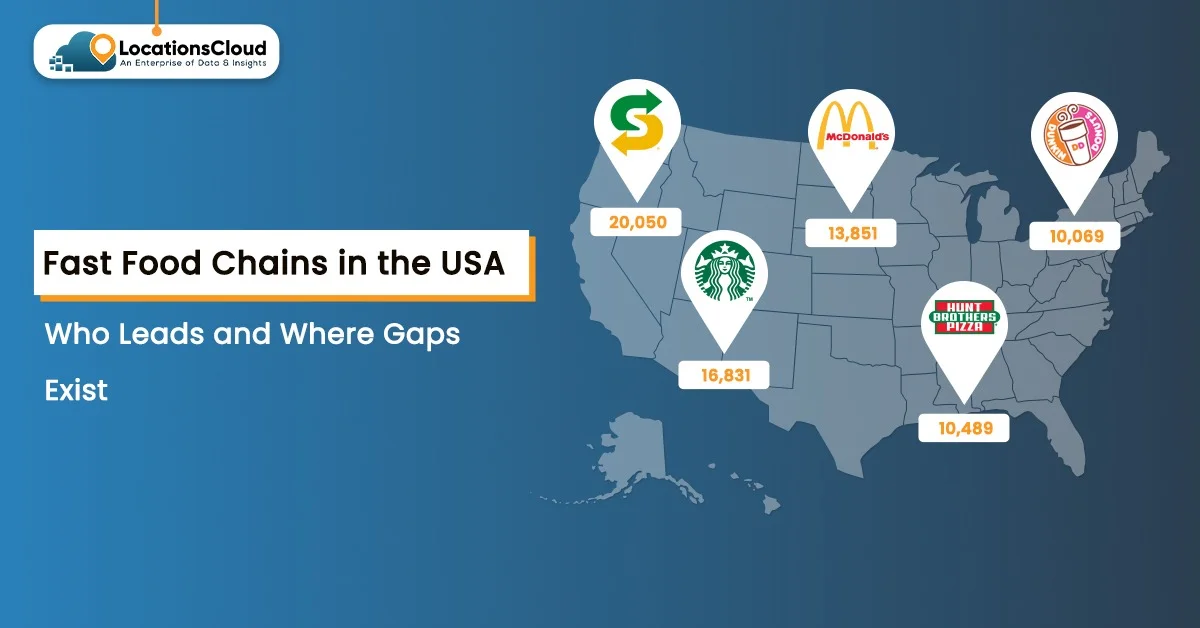
We have researched restaurant location data for Subway, McDonald’s, and Starbucks. These fast food brands are the largest fast food chains in the USA based on the number of locations, so we are comparing these three. Subway is the largest, with 20,050 stores in 51 states and territories. Starbucks has 16,831 stores in the US, and McDonald’s has just 13,851.
Which Fast Food Chain Has The Most Locations In The USA?
| Rank | Brand | Number of Locations | States Present In | Cities Present In |
| 1 | Subway | 20,050 | 51 | 6,567 |
| 2 | Starbucks | 16,831 | 52 | 3,851 |
| 3 | McDonald’s | 13,851 | 54 | 5,038 |
| 4 | Hunt Brothers Pizza | 10,489 | 36 | 4,529 |
| 5 | Dunkin Donuts | 10,069 | 44 | 3,430 |
The location analysis of the biggest food chains in the United States shows how geographic reach, accessibility, and expansion strategies are important in establishing brand dominance.
Subway comes in first with 20,050 locations showing its expansive reach in 51 states and 6,567 cities. The company’s wide franchise model has helped the brand to be in a variety of communities, including smaller towns and suburban areas.
Starbucks, with 16,831 locations in 52 states (52), showcases its dominant national presence and focus on high-traffic urban and commercial areas.
McDonald’s has 13,851 locations in 54 states and 5,038 cities as a consequence of a very mature franchise system and strong brand awareness.
Hunt Brothers Pizza has a different approach to expanding its business. With 10,489 locations in 4,529 cities and 36 states, it’s found a niche in non-traditional venues such as convenience stores and gas stations. This approach opens the way for the brand to enter underserved markets with lower infrastructure costs.
Dunkin’ Donuts is quite popular regionally, with a total of 10,069 locations in 44 states and 3,430 cities. It is very popular for coffee and breakfast.
The overall analysis shows that location scale is an important competitive advantage in the U.S. food industry. Brands with a wider geographic reach have the benefit of reaching more consumers, increasing brand awareness, and creating more market opportunities. But the scarcity of locations in underserved markets might provide opportunities for emerging brands to grow.
Identifying Underserved Markets and Untapped Opportunities
Based on the geographic coverage and brand distribution, we can identify a number of potential market gaps. When analyzing the US fast food POI dataset and restaurant location data in the USA. Big chains such as Subway, Starbucks and McDonald’s have wide networks, but there are still gaps, particularly in rural communities, smaller cities and low-density suburban areas. The difference in the presence of the brands’ locations indicates growth opportunities where demand is present, but the number of restaurants is limited.
Hunt Brothers Pizza is an example of how brands can capture these gaps through alternative expansion models, such as convenience stores and non-traditional locations. Opportunities may arise in the future in areas with fewer quick-service restaurant options in developing segments such as healthier fast food, affordable meal choices, and localized menus. Fast food chains can identify underserved markets and develop targeted expansion strategies to improve market access and competitiveness by analyzing restaurant location trends, population growth, and consumer preferences.
Best Locations for Fast Food Chain Expansion in the US
Analyzing restaurant location data in the USA and QSR location data in the USA helps in identifying high-potential areas for fast food chain expansion. The best opportunities are in fast-growing suburban communities, emerging cities, and underserved rural markets where population growth is driving demand for convenient dining options. Strong population growth states Texas, Florida, Arizona, North Carolina are attractive places to expand when consumer demand is growing, and business-friendly states are available.
Location analysis also finds gaps in areas with fewer quick-service restaurant (QSR) outlets relative to the population size. Fast food outlets can be set up in smaller cities, transportation hubs, college towns, and residential developments. Restaurant location datasets provide geographic insights that brands can use to identify markets with less competition, greater customer access, and high growth potential. In the U.S., fast food chains could strategically expand into these areas to attain greater market penetration and establish competitive advantages.
Conclusion
The U.S. fast food market is highly competitive, with Subway, Starbucks, McDonald’s, Hunt Brothers Pizza, and Dunkin’ among the top brands with strong positions due to their large number of locations and successful expansion strategies. An analysis of the restaurant location data in the USA and QSR location data in the USA shows that geographic reach is important to brand visibility and customer access. Major chains are well established in mature markets, but there are opportunities in underserved markets, developing suburbs, and emerging cities. The opportunities for fast food companies to expand strategically and competitively in the changing foodservice landscape of the United States can be found through location gaps and consumer demand patterns. Opening a new restaurant? Contact LocationsCloud, the best QSR POI data provider, to find the best location for your business.
FAQs
How can location data reveal regional fast food trends?
Location data reveals restaurant chain concentration, underserved markets, and variation in brand presence by state and city. This data helps organizations analyze and forecast regional fast food trends.
What data fields are usually included in a fast food POI dataset?
A fast food POI dataset includes name, category, cuisine, address, city, state, postalCode, latitude, longitude, and phone.
How can businesses find fast food expansion opportunities?
Businesses can hire a fast food location data provider to find the best location to gain more profit or fast food expansion opportunities.
What does “market gap” mean in fast food location analysis?
A market gap in fast food location analysis is an area where there is customer demand but a shortage of fast food restaurants or particular brands. Restaurant location data is analyzed to discover underserved areas, which ultimately provides opportunities for restaurants to expand further.
Why is location count important for fast food chain analysis?
Location data reveals a brand’s reach in the market, customer accessibility, and competitive strength in various markets. The more locations, generally the more brand presence it has and gaps in locations can mean potential for growth.
Explore the Fast Food Market Now
See who’s leading in the USA fast food industry and uncover opportunities for growth and market gaps.
Contact Us