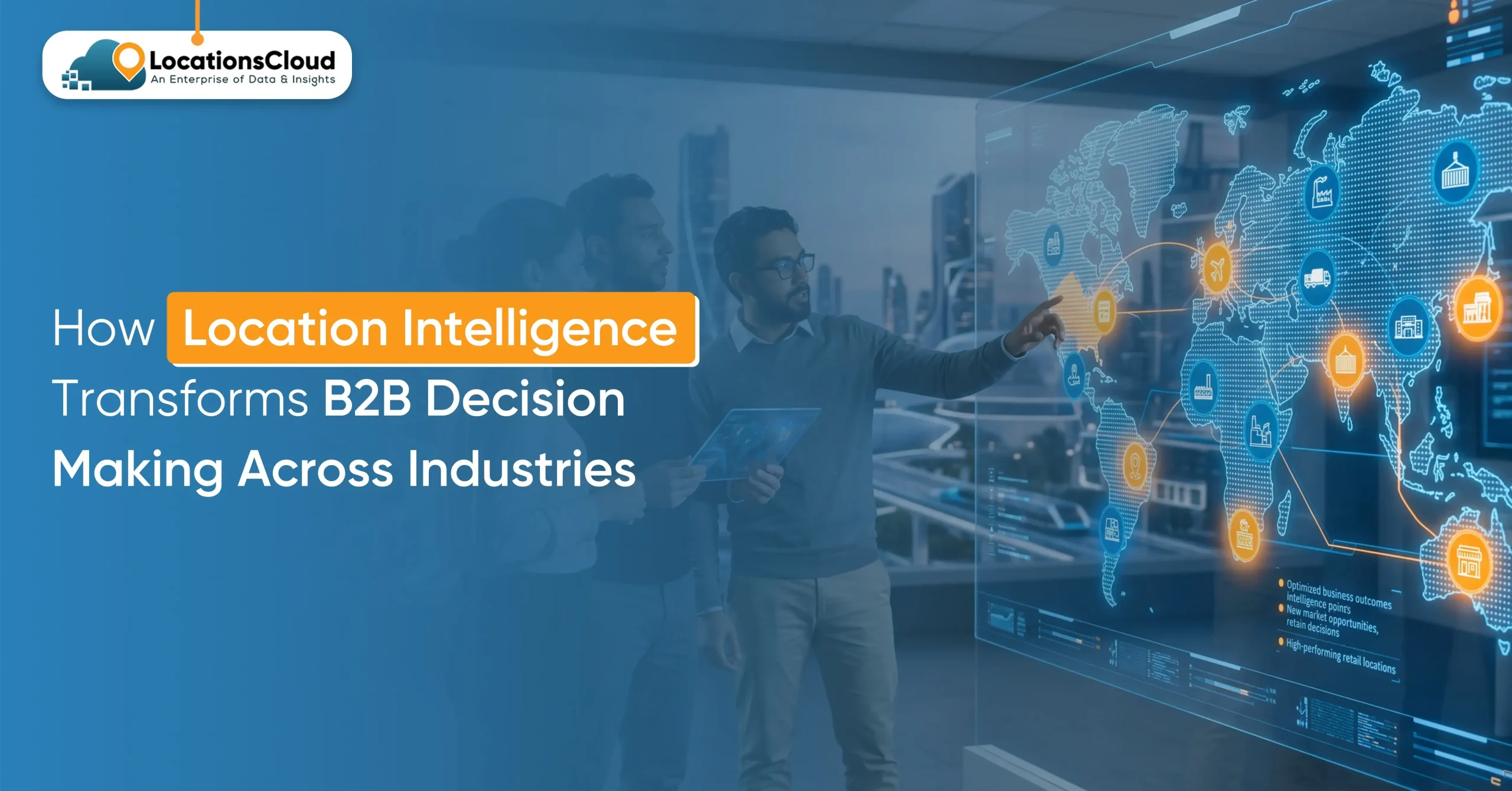
The current-day data-driven economy does not dictate that businesses use intuition or historical trends to make strategic decisions. Instead, they are resorting to location intelligence, a potent blend of geospatial data, analytics, and visualization tools, to learn more about markets, customers, and operations. Location intelligence helps organizations to comprehend not only what is going on, but also where and why, and opens a new dimension of decision-making that is particularly useful in the B2B environment.
Fundamentally, location intelligence is the combination of geographic information and traditional business information that enables businesses to chart trends, uncover business opportunities, and reduce business risks in a more efficient manner. It could be supply chain optimization, choice of the best expansion locations, or better customer targeting, but in any case, this technology has become a pillar of contemporary businesses in any industry.
Improving Market Analysis and Expansion Strategies
Market analysis is one of the most influential uses of location intelligence in the B2B decision-making process. Demographic, economic and behavioral data related to particular regions help businesses to understand high potential markets with accuracy. Companies can analyze the population density, purchasing power, the presence of competitors and local demand patterns, rather than making general assumptions.
To illustrate, a construction materials dealer planning to expand to new areas can adopt location intelligence to identify areas that are witnessing high urbanization. The company can strategically locate where they can be most needed by mapping construction permits, infrastructure projects, and housing trends. This kind of understanding minimizes the risks involved in growth and better resource allocation.
Enhancing Supply Chain and Logistics
Location intelligence is transformative in the optimization of logistics that is critical in B2B operations. Companies are able to trace the path of goods and determine the bottlenecks and to develop more efficient distribution systems. Through transportation route analysis, establishment of transportation patterns, and closeness to major suppliers or consumers, the companies would save a lot of money and enhance the delivery time.
As an example, manufacturers could utilize geospatial information to identify the most effective locations of warehouses according to their distance to the raw materials and final customers. This not only reduces the transportation costs but also improves the responsiveness to market needs. These efficiencies may have a direct effect on profitability in a business where time is of the essence, like in the case of perishable foods or construction materials.
Enhancing Customer Segmentation and Targeting
Knowing customers on a very detailed level is the key to B2B success, and location intelligence will be a distinct benefit in this sphere. Using the geographic data with the profiles of customers, businesses may better segment their audience and provide more region-specific offerings.
A case in point, a firm providing vinyl siding services Dartmouth can study the local climate conditions, house designs and renovation tendencies to more effectively appeal to the prospective customer. Regions that have more aged housing or worse weather conditions might have more demand on upgrading siding and the business will be able to concentrate on the area where they are most likely to give returns. The use of this focused strategy not only increases the conversion rates but also reduces the loss of investment.
Enhancing Risk Management and Compliance
Another important area where location intelligence is invaluable is risk management. Companies can evaluate geographic risks such as natural disasters, political unrest, regulatory changes, and Geopolitical Risk Monitoring to identify potential threats that may affect business operations and make more informed strategic decisions. This can be achieved by visualizing such risks on a map, which allows decision-makers to proactively prepare contingency plans and prevent expensive disruptions.
As an example, firms with operations in various locations are able to track environmental hazards, such as floods, earthquakes, or severe weather conditions. This enables them to realign supply chain routes, find inventory or temporarily relocate to secure locations. Moreover, location intelligence can be used to guarantee adherence to local regulations by offering insights on zoning laws, environmental restrictions, and local policies.
Making Smarter Site Selection
The selection of an appropriate location of offices, warehouses, or retail stores is a risky move in B2B businesses. Location intelligence offers more straightforward data-driven suggestions about possible locations, making it a simpler process. The accessibility, infrastructure, availability of labor and closeness to customers or partners are some of the factors that the businesses can consider.
In a logistics firm seeking to open a new distribution center, one can consider the transportation network, traffic movement, and demand in the delivery of products . Through visualization of these variables, the firm will be able to determine the best place that will give them the best price and service. This minimizes the amount of guesswork and makes sure that the location of the site is not contrary to the long-term business goals.
Enabling Competitive Advantage
Location-based insights can be a great advantage in a highly competitive B2B market. Enterprises are able to watch the activity of competitors, find the areas that are under-serviced, and discover new ways of differentiation. Knowing the areas in which the competitors are doing well or where they are performing poorly, companies are able to improve their strategies in order to gain market share.
An example would be where a B2B service provider can map out competitor locations and superimpose the data of customer demand to determine the مناطق with high demand and minimal competition. This helps the company to strategically position itself and establish a presence in the new markets before its competitors realise that.
Promoting Resource Optimization and Sustainability
Businesses have made sustainability a major concern and location intelligence helps make decisions that are more eco-friendly. Companies can reduce their environmental footprint by minimizing fuel usage, waste, and waste, which can also reduce costs by optimizing routes.
In the case of organizations, geospatial analytics may be used to create energy-efficient logistics systems or to locate where renewable energy production is possible. Location intelligence can also be used in such industries as construction or manufacturing to obtain materials in the area of their use, minimizing transportation emissions and contributing to sustainable operations.
Conclusion
Location intelligence is no longer a niche feature- it is now an essential aspect of B2B strategic decision-making. With geographic, business data integration, organizations are able to make smarter, faster, and more informed decisions about all aspects of their operations.
The uses of location intelligence are immense and game changers, whether it is market analysis and supply chain optimization or targeting customers and risk management. With technology ever changing, those businesses that adopt this strategy will be in a better position to stay afloat as they continue to face complexity, grasp opportunities and have sustainable growth.