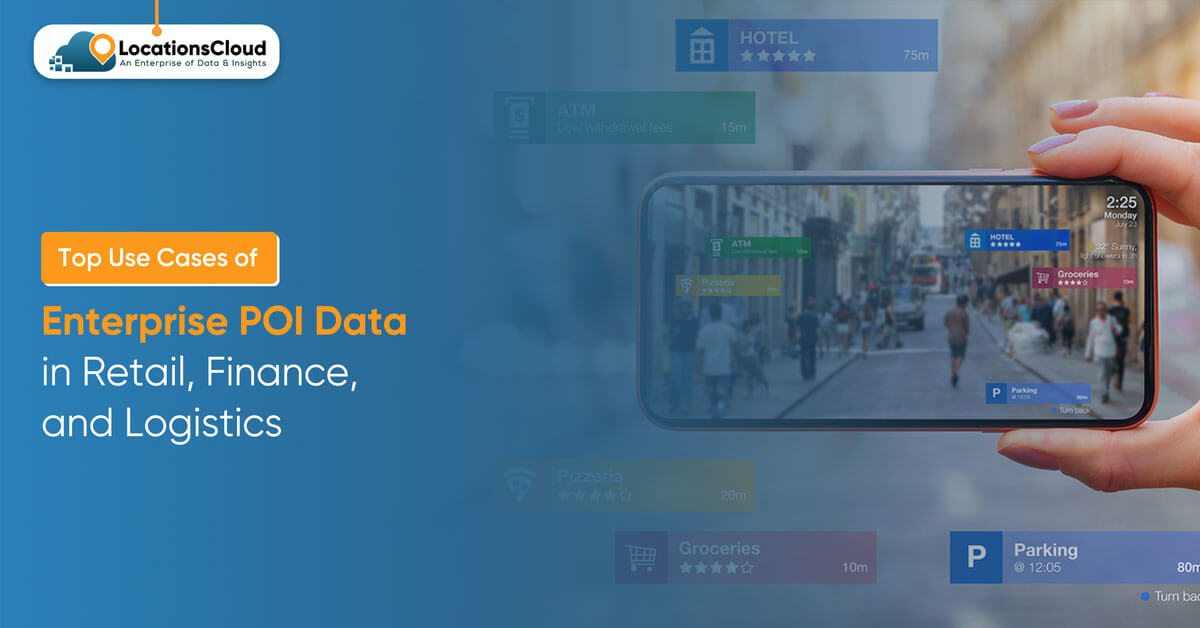
Organizations are now actively trying to make every data point into a competitive edge. Within that, enterprise POI (point of interest) data is becoming an increasingly important asset. POI data is the curated information about physical locations and stores.
When used, POI data enables organizations to make next level decisions related to expansion decisions, risk management, customer segmentation, logistics operations and many other domains. In industries like retail, finance and logistics, where geography, movement and proximity are important, POI data helps in translating “where” into insights related to “why” and “what next”.
As the digital and physical worlds meet, organizations can no longer afford to overlook the spatial context of their business environment. In this blog we will explore some use cases of enterprise POI data in three important verticals–retail, finance, and logistics–and demonstrate how leading firms use high quality datasets of POIs to achieve growth, reduce risk, and improve performance outcomes.
What is Enterprise POI Data?
Before examining use cases, it is valuable to explain what enterprise POI data is. Simply put, POI data identifies and describes relevant physical locations (points of interest) with attributes (type of place, size, customers/foot traffic, proximity to other places, hours of operation, etc.). This means data is rich enough, clean enough, validated, and maintained for mission-critical usage and not just casual usage in mobile apps.
Quality enterprise POI data is the foundation of a decision because it supplies completeness, accuracy, currency and relevance. Let us discuss how the data is used for specific industry verticals.
The Role of POI in Competitive Intelligence
Competitive intelligence extends beyond simply tracking prices or promotions; it begins with understanding a competitor’s where and a competitor’s why. With POI (Point of Interest) data, an enterprise can visualize and scrutinize competitors’ locations, serveable markets, the accessibility of customers, all with spatial accuracy. If a business maps competitors’ stores, branches, or distribution centers alongside complementary amenities, for instance parking, transport hubs, and residential clustering, the business is gaining knowledge of their competitors’ strategic intentions.
POI data also uncovers zones of market saturation, and zones of whitespace, where customers are present at greater, or less, proximity while competitors generally underperform. Retailers can use POI data to assess a neighborhood or town dominated by competitors, or marked by a recent competitive expansion, then make a more informed decision regarding expansion strategy or repositioning. Banks can assess the density of ATMs to optimize their own network.
POI data changes competitive intelligence from a mundane and static benchmark to something much more interesting, and location aware, a dynamic action oriented strategy map. Businesses are empowered to keep moving ahead of competitors, focus on underserved segments of markets, and make better decisions based on geography.
Use Cases in Retail
In the retail sector, much of success is contingent on where you are located – enterprise POI data helps brands gain clarity in these situations. Below are some examples of retail applications of POI:
a. Site Selection
One of the highest value retail applications of enterprise POI data is strategic site selection. Before a retailer opens a new store, it can use POI data to map competitor locations, foot-traffic indicators, and demographic catchments in a certain area. This allows retailers to determine the best places with latent, unmet demand. Retailers can determine the best locations to capitalize on visibility by looking at the POIs of competing stores. They can also capitalize on convenience by looking at the highest foot traffic. Studies suggest that the accuracy and reliability of site selection is greatly increased with spatial data.
b. Market Expansion and Coverage Gaps
POI datasets lend retailers the opportunity to assess market coverage at a scale beyond their individual locations. By layering POI data (existing stores, competitor locations, consumer amenity clusters) alongside demographic and mobility data, retailers can identify coverage gaps-areas where there is customer demand that is either not served, or underserved by the retailer. This leads to better decisions with respect to new cities, submarket expansion, or targeted store formats as retailers can allocate capital more efficiently while avoiding cannibalization and saturation.
c. Foot-Traffic & Customer Behaviour Insights
POI data also provides deeper customer behaviour insights-such as where customers are coming from, which POIs they are visiting before or after the store, and how a retailer’s competitors are attracting or losing customers. A store, for example, would scan the surrounding POIs such as transit locations, entertainment venues, or workplaces to inform expectations on peak hours or to design services accordingly. Overall, POI insight that can lead to more targeted marketing, tailored store experiences and improved conversions.
d. Competitive Intelligence
Enterprise POI data assists retailers in increasing competitor intelligence with a clearer spatial understanding. By visualizing competitor store POIs and or other service locations, such as attributes (size, brand, category type, opening hours) that allow evaluation of intensity of competition from retail competitors in a submarket, retailers can more easily determine repositioning, format, or capture quiet areas in the market.
Use Cases in Finance
Location intelligence is emerging as a hallmark of better decision-making within the finance/insurance world. Enterprise POI datasets allow institutions to unveil spatial patterns that affect the way accessibility, risk, costs, and consumer actions occur. Here’s a summary of how you can leverage POI data and enhance finance operations:
a. Branch / ATM Network Optimisation
For banks and finance institutions, POI data can assist with expansion or rationalisation strategies of a branch or ATM network. By overlaying potential POIs of branches or ATMs with competitive branch POIs, consumer amenity POIs (e.g., malls/offices) and demographic clusters to better locate service points, finance firms can better optimise the coverage of the networks while ensuring accessibility for consumers, while also reducing operating costs. Research has also illustrated that banks use POIs to assist with market penetration strategies.
b. Risk Assessment & Fraud Detection
POI data can also serve as a relevant variable in risk modelling and detecting fraud. For example, an insurer can investigate the POIs associated with properties and assess risk by reviewing their exposure in a physical space (industrial sites, flood-prone regions, dense residential clusters), and use this to calibrate premiums or coverage to the owners in relation to exposure. In finance, transaction location POIs that are incorporated with cardholder behaviour can identify anomalies (e.g., the POI of an ATM being used in a location far away from the cardholder’s normal routine) and monitor the potential of fraud taking place.
c. Customer Segmentation & Product Marketing
Financial institutions also leverage POI data for customer segmentation and hyper-local / marketing. For example, by identifying clusters of POIs around high-income populations (luxury trips, high-income residents), banks can offer best in class service offerings, wealth-management services, or credit services in those target neighborhoods. In a similar way, banks can also use POIs to map underbanked communities (few bank branches and credit deserts) with the aim of launching outreach programmes or digital services to fill in that gap.
d. Investment & M&A Decision-making
POI data is relied upon in assessing commercial real estate or consumer-finance investments. With POI data representing business establishments, infrastructure, transportation and consumer patterns/flow in a region, financial firms can understand the vibrancy of a location and make educated decisions regarding acquisitions or partnerships.
Use Cases in Logistics & Supply Chain
The POIs are important in logistics & supply chain management. Understanding spatial relationships between distribution hubs and delivery routes can yield significant efficiencies and cost savings. Below, we discuss the very significant use cases POI data can have on logistics operations.
a. Last-mile delivery optimisation
Enterprise POI data can help logistics businesses map high-density POIs (e.g., clusters of customers in a residential or business context), drop off or pick up points, serviceable zones, or accessibility constraints (like narrow roads or loading zones). Logistics companies use POIs in their data sets to inform delivery zones and lower fuel and time costs. While the use of POIs in logistics is not new, a deeper understanding of POI data, particularly referencing enterprise systems, will continue to become more common in developing logistics strategies.
b. Warehouse and distribution centre locations
When logistics or supply chain managers are considering new warehouse or distribution centre locations, POI data can also be helpful in logistically planning sites. POI data helps evaluators consider the locations of the new warehouse or distribution centre relative to major transport hubs, major customer catchments, and proximity to distribution points for competitors or partners POIs (eg, fulfilment point for a large retailer). Once evaluators are familiar with the spatial ecosystems of POIs, they can reference supplier and customer POIs to improve their location selection process for speed and/or delivery cost.
c. Fleet & Network Management
Enterprise POI datasets help fleet managers identify popular POIs (industrial parks, logistics hubs, turnaround zones) and design route networks that avoid unnecessary congestion, reduce idle time and leverage high-performance nodes. POI-based analytics help generate dynamic scheduling, load balancing and operational agility.
d. Service Area Definition & Geofencing
Logistics providers use POI data to define serviceable polygons or zones around clusters of POIs, which allows them to appropriately geofence pickup or drop zones and utilize real-time monitoring, notification triggers and overall customer experience. Spatial clarity from POI data helps advanced logistics service models.
Implementation Considerations & Best Practices
When deploying POI driven initiatives to enterprise scale, organizations should aim to follow several best practices:
1. Data Quality and Recency
High value POI data should be accurate, timely and certified. Inaccurate or out of date POI data can encourage bad decisions and operational failure.
2. Integration and Analytics Engine
POI data does not provide value in and of itself. Integration of POI data with contextual business data (sales, demographic, mobility, financial) and developing spatial analytics is necessary. Complementary data layers add dimensions of insight.
3. Aligned to Business Strategy
POI initiatives need to be aligned with strategic outcomes (growth, cost reduction, risk). For example, as a retailer considers opening new stores, they should use POI insights for ROI models, demographic catchment assessments and competitive mapping.
4. Privacy, Compliance & Ethics
Particularly integrating POI data with behavioral or mobility data sets, it is important to always consider the ethical and compliance implications. The enterprise must ensure that the POI provider engages in ethical sourcing practices, and appropriate consent mechanisms.
Conclusion
In conclusion, enterprise Point of Interest data is not just an ancillary dataset anymore; it is a key component of next-generation business strategy, whether in retail, financial services or logistics. From identifying the best retail store front to optimizing branch networks, managing delivery fleets, or simulating future growth regions, Point of Interest data translates the reality of physical space into usable insight.
As businesses work further towards customer-centricity, efficiency and resilience, the ability to map and understand “where” things happen is a competitive advantage. However, the value is not just the data alone, the value comes from integrating and analyzing the data and then aligning it with business objectives. Organizations that integrate POI-informed spatial thinking into their operating models will outperform their competition and lead their organizations into the future.
At the center of this transformation is quality: data that is accurate, up to date, and sufficiently complete. When quality is achieved, businesses can leverage POI data to support decision making and see a measurable value through geography across business domains. In effect, enterprise POI data is a strategic investement that supports growth, cost avoidence, and risk management-and the time to act is now.
At LocationsCloud, we recognize the significant importance of reliable POI data. We provide high-quality, accurate, and updated data on location datasets to meet your business needs. LocationsCloud is the one-stop data solution provider if you are expanding your business needing to improve your location-based service offerings. By providing datasets that have been curated for enterprise use, we offer seamless integration with your analytical stack, compliance and robust validation. With LocationsCloud you gain insights that drive strategic growth and operational excellence. Contact us today to learn more about our services in much detail.
FAQ
1. What does the term Enterprise POI Data mean?
Enterprise POI (Point of Interest) data consists of organized, curated and verified facts about physical locations – stores, ATMs, offices, warehouses, and so on. POI datasets will typically have geographic longitude and latitude coordinates, type of location, square footage, amenities nearby, and traffic counts. Enterprise POI data is highly precise, curated, and up-to-date, unlike generic location data, and provides a decision-making opportunity across multiple verticals.
2. What is the difference between enterprise POI data and generic location data?
Enterprise POI data is broader, verified, and dynamic compared to generic location data. POI data is structured to provide business-grade applications by ensuring accuracy, completeness, and relevancy. Generic location data can be inaccurate, incomplete, out of date, or not relevant, whereas enterprise POI datasets are updated, verified, and enriched to support the analysis, forecasting, or real-time decision making needed by a variety of industries.
3. How does POI data assist with competitive intelligence?
POI data helps organizations assess competitor presence (in the geographic region), distribution networks, and supportive businesses nearby. Mapping competitor POI around businesses (POI relationship mapping) allows businesses to identify where they are saturated, identify white space, and develop a strategy to grow. This leads to the ability to differentiate the business strategically, change pricing, and focus marketing efforts. In essence POI driven intelligence helps enterprises gain the spatial clarity necessary to create, leverage and grow competitive advantages against the competition sustainably.
4. How does POI data enhance customer experience?
POI data supports businesses in understanding the movement, preferences, and accessibility of customers. By identifying customers’ home locations, shopping and travel habits, brands can suggest location-based recommendations, targeted, personalized promotions, and a more optimized service continuum. This allows for seamless omnichannel experiences and builds stronger relationships based on convenience, relevance, and close engagement of consumers across customer journeys.
5. How often is POI data updated?
In order to ensure accuracy, POI data requires continuous updating – at least every few weeks or months. Regular updates that demonstrate whether new businesses are opening, whether the business has closed or relocated, and/or whether infrastructure changes have occurred. LocationsCloud is like a continuous updated version; our POI data is always validated and current, whether businesses are getting the most accurate and reliable location information.
6. Why are you confident that LocationsCloud is a preferred provider of POI data?
LocationsCloud offers location data as a provider with accuracy assurance, and ethical data usage with frequent updates. The datasets that LocationsCloud offers are often industry-specific, customizable, and compatible with numerous leading analytics platforms. Clients are able to access advanced filtering of the dataset, geospatial accuracy, and compliance with privacy laws around the world. More than a data provider, LocationsCloud is a trusted partner in helping businesses make data-driven decisions.